Skip links
Integrating Regulatory Compliance Elements into the Protocol
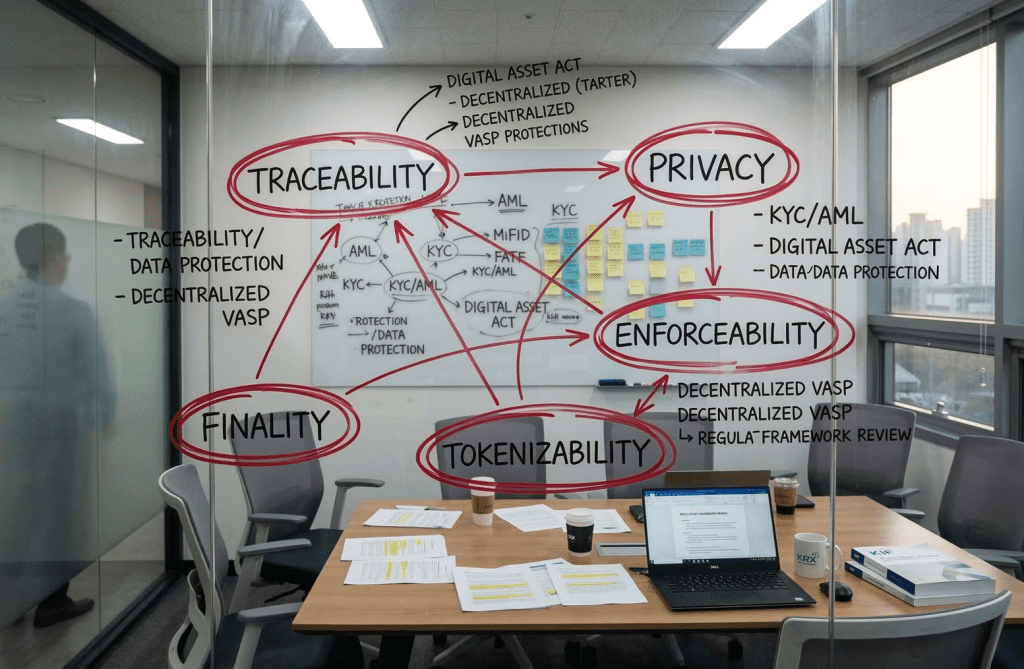
In the world of oracle state synchronization, regulatory compliance is not optional but essential. Integrating regulatory compliance mechanisms into the Oracle Interoperability Protocol (OIP) represents a fundamental challenge for implementing tokenized capital markets. This research presents a concrete technical approach to realizing the five core principles of the Regulatory Compliance Protocol (RCP)—completeness, traceability, confidentiality, enforceability, and tokenizability—in an on-chain environment through a NEW-EIP proposal that extends the ERC-1400 security token standard. We provide detailed explanations of how automated verification and enforcement mechanisms for regulatory compliance can be implemented by extending the ERC-1643 document management standard and the ERC-1644 controller operations standard.
Oraclizer Core ⋅ Jun 10, 2025

Bond Market Digital Transformation: A Case Study
The bond market still relies on T+2 settlement, manual coupon processing, and fragmented compliance. This case study simulates how tokenized bond lifecycle management transforms through oracle state synchronization, covering real-time collateral valuation, automated regulatory compliance, and coupon payment innovation via DAML, OIP, and OSS.
Oraclizer Core ⋅ Jun 10, 2025

D-quencer Algorithm Overview
D-quencer is Oraclizer's decentralized sequencing engine that provides Stage 1 rollup-level security. Through a consensus algorithm utilizing BLS (Boneh-Lynn-Shacham) signature-based VRF (Verifiable Random Function), it ensures fair sequencer selection and transaction reliability. In particular, by employing equal stake PoS and multisig-based consensus, it achieves a balance between scalability and security, providing the core foundational technology for regulatory-compliant oracle state machines.
Oraclizer Core ⋅ Jun 10, 2025
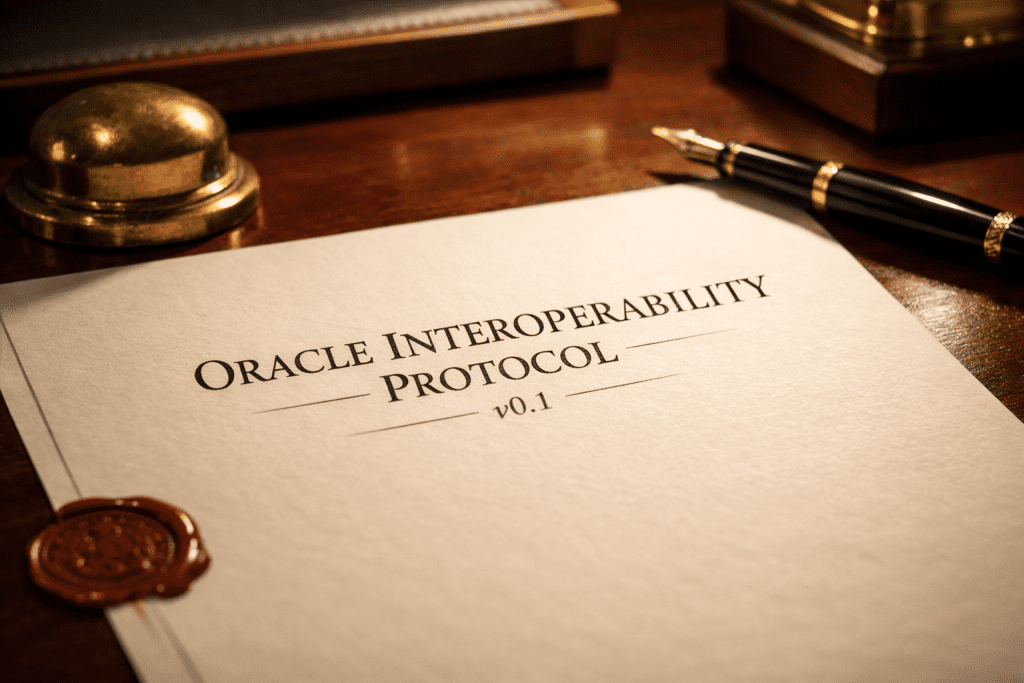
State Synchronization Message Format: OIP v0.1 Specification Release
We're officially unveiling the state synchronization message format for OIP v0.1. This comprehensive specification includes JSON Schema-based validation systems alongside practical implementations in TypeScript, Rust, and Go. We share the technical challenges we faced during development, particularly around cross-chain identity management and regulatory action standardization, while demonstrating how the OCID (Oracle Contract ID) system achieves seamless on-chain and off-chain identity integration through real-world code implementations.
Oraclizer Core ⋅ Jun 04, 2025
Core Components of the Oracle State Machine
Oraclizer's state synchronization architecture consists of five core components: Polygon CDK-based L3 zkRollup infrastructure, zkVerify integrated verification engine, Base L2 bridge connection, Oracle State Synchronizer (OSS), and RWA Registry contracts. Each component performs a specialized role, working together to enable the entire system to complete state synchronization. Particularly, the modular architecture of Polygon CDK and verification optimization through Horizen Labs' zkVerify have made bidirectional real-time state synchronization economically viable—something impossible with traditional oracle systems.
Oraclizer Core ⋅ Jun 04, 2025
Standards Track EIP: RCP-based Security Token Standard Proposal
Over the past few years, the Ethereum ecosystem has continuously strived for security token standardization. While standards like ERC-1400 and ERC-3643 have made significant progress, they haven't fully met the complex and evolving requirements of global financial regulators. Particularly, for tokenized capital markets to enter the institutional realm, more comprehensive and sophisticated regulatory compliance mechanisms are essential.
Oraclizer Core ⋅ May 28, 2025
EIP Proposal Strategy: RCP and Compatibility with Existing Standards
Integrating Oraclizer's Regulatory Compliance Protocol (RCP) into the Ethereum ecosystem is not merely a technical standard proposal, but a strategic challenge of balancing regulatory compliance with innovation. Moving beyond the limitations shown by existing standards like ERC-1400 and ERC-3643, RCP presents a comprehensive framework that systematizes 31 core requirements from 15 global financial regulatory agencies. Our approach centers on a modular EIP strategy that can achieve genuine regulatory compliance while maintaining compatibility with existing ecosystems.
Oraclizer Core ⋅ May 28, 2025
The Technical Advantages of Oraclizer Core Architecture
L3 zkRollup architecture serves as Oraclizer's core technological foundation, with its adoption primarily driven by overwhelming advantages in scalability and economic efficiency. In particular, the revolutionary cost efficiency of over 93% gas reduction serves as a decisive differentiator in systems requiring continuous transactions like state synchronization. Additionally, the L3 layer design opens new technological horizons that existing oracle solutions haven't reached in terms of data compression efficiency, processing pipeline optimization, and modular scalability. This isn't merely a technical choice, but an essential architectural decision to realize the innovative paradigm of next-generation oracle state machines.
Oraclizer Core ⋅ May 21, 2025
Financial RWA and Oracle State Synchronization
Financial real-world assets (RWAs) represent the most promising area in the tokenization market, but their practical utilization is limited due to state inconsistency between off-chain and on-chain environments. Oraclizer's state synchronization technology overcomes these limitations to enable complete on-chain integration of financial RWAs. Built on the Regulatory Compliance Protocol (RCP), this technology meets the strict requirements of financial institutions while ensuring contract completeness through real-time reflection of asset states. This forms a genuine connection between financial RWAs and DeFi, moving beyond the simple data transmission of existing oracle systems.
Oraclizer Core ⋅ May 21, 2025