Skip links
OIP v0.5 Checkpoint: Three Discoveries and the Big Map
OIP v0.5 closes the specification integration review: cumulative protocol decisions are placed on one table and checked for coherence across five design areas. Three discoveries emerge: a missing header slot for threshold signatures, redrawing validation as criteria rather than axes, and recognizing BVC and 3-Phase as nested layers.
Oraclizer Core ⋅ Apr 26, 2026

Message Types and Routing: The OIP Communication Protocol
OIP defines seven message types and a Content-Based Routing protocol that determines delivery paths from message content itself. This specification completes the communication backbone before the v0.5 checkpoint by connecting Lock Status, regulatory actions, and address resolution into a system that actually moves.
Oraclizer Core ⋅ Mar 04, 2026
When 0x742d35… Exists on Four Chains: How OIP Resolves Address Ambiguity
This study examines address ambiguity in cross-chain environments where identical addresses exist across multiple chains, and how OIP integrates ERC-3770 to enable precise targeting of regulatory actions. We compare CAIP-10 and ERC-3770 design philosophies and present the address resolution pipeline within OSS
Oraclizer Core ⋅ Jan 10, 2026
Asset State Management Complexity: Introducing Lock Status Architecture
Simple 5-tier lock states could not fully resolve priority conflicts between regulatory authorities, time-based state transitions, and cross-chain atomicity issues. This research presents implementation approaches to meet complex real-world financial system requirements through State Transition Automata-based methodologies and Hierarchical Lock Mechanisms.
Oraclizer Core ⋅ Oct 25, 2025
OIP v0.2 Development Log: Core Improvements
After several months of simulation and theoretical analysis following the OIP v0.1 release, we've discovered that state synchronization demands fundamental system redesign beyond simple message format specifications. v0.2 introduces four core improvements
Oraclizer Core ⋅ Aug 31, 2025
The Identity Dilemma: Birth of the OCID Concept
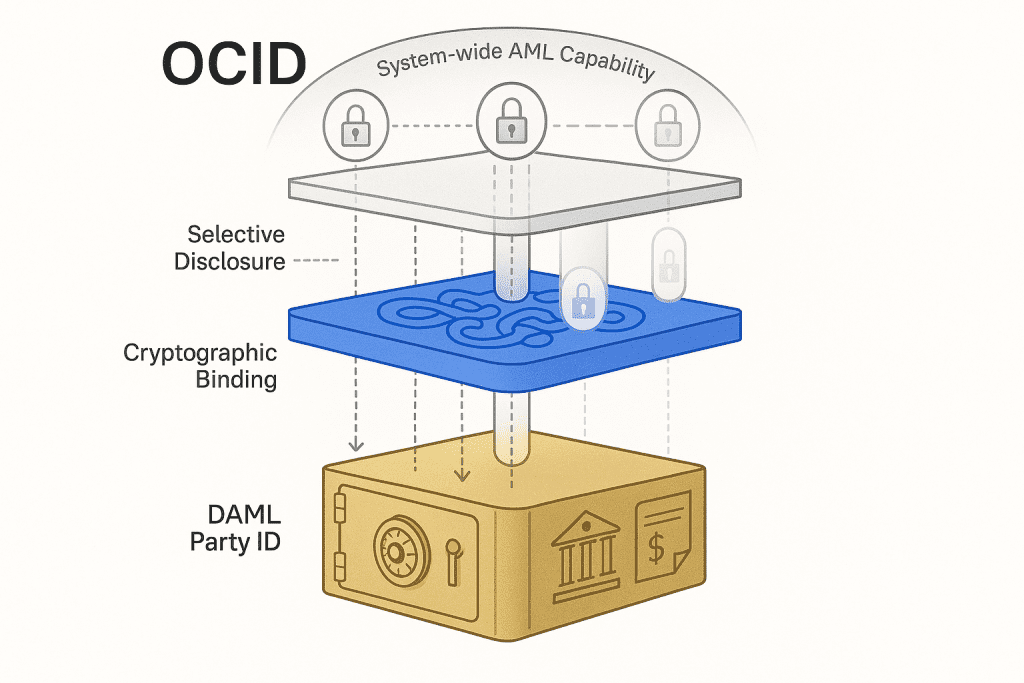
OCID presents an innovative approach as oracle technology's first identity management system, enabling system-wide AML (Anti-Money Laundering) while protecting personal information. Through the process of combining DAML Party IDs, zero-knowledge proof-based identities, and cross-chain addresses into a unified identifier, we proved that the technical coexistence of contradictory values—privacy and regulatory compliance—is possible.
Oraclizer Core ⋅ Aug 15, 2025
OIP Basic Data Structures: Defining Core Elements
The essence of the Oracle Interoperability Protocol (OIP) lies in defining fundamental data structures for complex oracle state synchronization. While existing oracles remained limited to simple key-value data transmission, OIP provides a structured state representation system centered around four core elements: Asset, Identity, Contract, and Regulatory Action. These data structures transcend mere message formats, functioning as a semantic framework that enables complete state synchronization between on-chain and off-chain systems.
Oraclizer Core ⋅ Jul 20, 2025
Why State Synchronization Demands a Protocol
State synchronization is a complex orchestration that goes beyond simple data transmission, and this cannot be realized without a systematic protocol. In computer engineering, a protocol defines a common language and agreed behavioral patterns between systems—this is especially true in environments like oracle state synchronization where heterogeneous on-chain and off-chain systems must maintain perfect consistency.
Oraclizer Core ⋅ Jun 29, 2025
Integrating Regulatory Compliance Elements into the Protocol
In the world of oracle state synchronization, regulatory compliance is not optional but essential. Integrating regulatory compliance mechanisms into the Oracle Interoperability Protocol (OIP) represents a fundamental challenge for implementing tokenized capital markets. This research presents a concrete technical approach to realizing the five core principles of the Regulatory Compliance Protocol (RCP)—completeness, traceability, confidentiality, enforceability, and tokenizability—in an on-chain environment through a NEW-EIP proposal that extends the ERC-1400 security token standard. We provide detailed explanations of how automated verification and enforcement mechanisms for regulatory compliance can be implemented by extending the ERC-1643 document management standard and the ERC-1644 controller operations standard.
Oraclizer Core ⋅ Jun 10, 2025
1