Skip links

EIP

ERC-8319: A Citable Regulatory Constitution for Tokenized Assets
The ERC-8319 Regulatory Compliance Protocol has entered Ethereum's standards repository. It defines the legal effect of six enforcement actions on tokenized assets, from a reversible freeze to an irreversible confiscation, and compiles 31 requirements from 15 regulators under five principles. A convention, not an interface, under one permanent, citable identifier.
Oraclizer Core ⋅ Jul 14, 2026
EIP-RCP: Why Tokenized Capital Markets Need a Regulatory
The EIP-RCP Informational EIP draft is now complete. This protocol provides a common vocabulary and framework for regulatory compliance interoperability in tokenized capital markets. This article explains the motivation, rationale, and significance of the proposal for the Ethereum ecosystem.
Oraclizer Core ⋅ Dec 20, 2025
The Dual-Track EIP Strategy: Independence, Governance, and Execution
Our dual-track EIP strategy (EIP-RCP and ERC-TRUST) is a philosophical necessity. Separating the conceptual framework from technical implementation creates independent value streams and resilient pathways for regulatory compliance, regardless of approval outcomes. This approach, supported by Horizen Labs, is crucial for building the institutional future of the Ethereum ecosystem.
Oraclizer Core ⋅ Dec 11, 2025
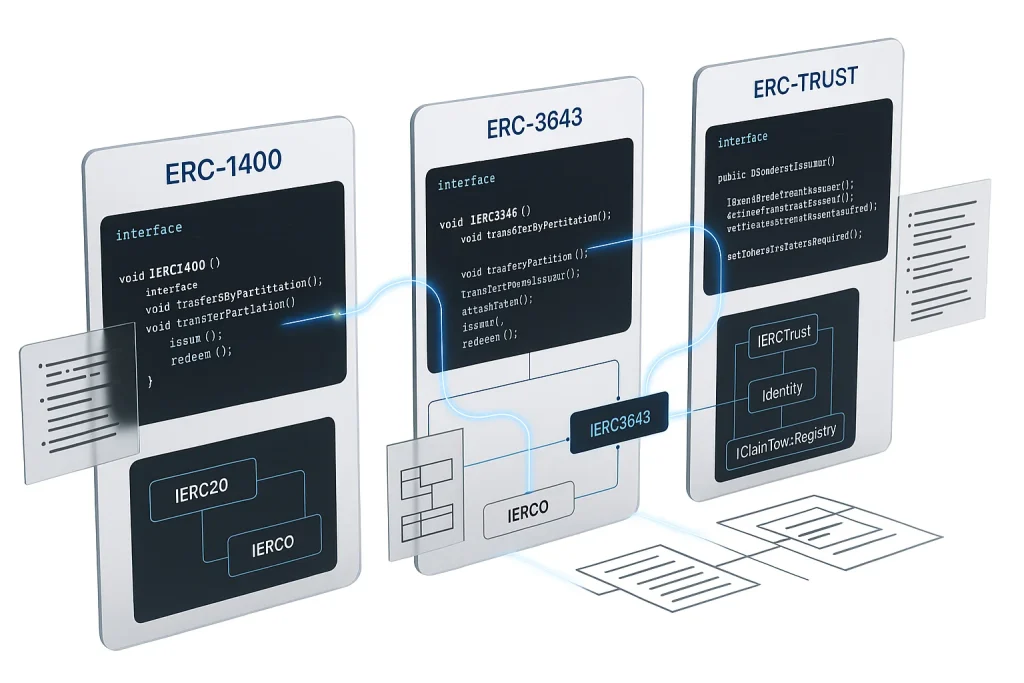
Dissecting ERC-1400 and ERC-3643: The Technical Case for a New Standard
A code-level analysis of why ERC-1400 and ERC-3643 cannot meet modern regulatory requirements. We examine the fatal limitations of controllerTransfer, fragmentation issues, and why extension is technically impossible. ERC-TRUST offers evolutionary succession—maintaining compatibility while implementing complete regulatory compliance for tokenized assets.
Oraclizer Core ⋅ Nov 30, 2025
From Philosophy to Reality: Why Enforceability Demands Its Own Standard
A fundamental gap exists between philosophical principles and executable code, and simple conceptual frameworks alone cannot secure actual regulatory enforcement. Informational EIPs define "what should be done" but suffer from structural limitations in presenting "how to implement". Regulatory authorities require actionable technical means, not recommendations, which must be implemented at the code level.
Oraclizer Core ⋅ Nov 01, 2025
From Theory to Implementation: Architectural Design for RCP Codification
This article explores how Traceability, Privacy, Enforceability, Finality, and Tokenizability are converted into an interdependent modular system, candidly sharing the design decisions we faced. We delve deeply into our ERC-1400 interface compatibility strategy, Diamond Pattern-based modular architecture, and the quest for balance between upgradability and immutability.
Oraclizer Core ⋅ Oct 09, 2025
Tokenizability: The Fifth Pillar of NEW-EIP
Tokenizability is not merely the ability to create digital tokens, but the comprehensive capability to preserve all essential properties of real-world assets—their temporal characteristics, regulatory classifications, and transfer restrictions—when representing them on blockchain. As the fifth pillar of RCP, it emerged from analyzing 31 regulatory requirements across 15 global financial authorities, addressing why financial institutions say "if a bond has no maturity, it's not a bond."
Oraclizer Core ⋅ Sep 07, 2025
Finality: The Fourth Pillar of NEW-EIP
There exists a fundamental philosophical conflict between blockchain's immediate finality and financial regulation's legal finality. RCP presents an innovative two-phase finality mechanism that implements PFMI Principle 8's requirements on-chain.
Oraclizer Core ⋅ Sep 05, 2025
Enforceability: The Third Pillar of NEW-EIP
Enforceability represents the most philosophically complex domain among NEW-EIP's five pillars. How do we justify centralized regulatory authority within a decentralized system? Our answer to this fundamental dilemma is a new paradigm called "Selective Decentralization."
Oraclizer Core ⋅ Aug 15, 2025
Privacy: The Second Pillar of NEW-EIP
Financial privacy is not merely a technical feature but a fundamental prerequisite for democratic financial systems. NEW-EIP's second pillar, Privacy, presents an innovative balance between regulatory compliance and personal data protection through the 'need to know basis' principle and the zk-basis ID system. To resolve the fundamental contradiction between GDPR's 'right to be forgotten' and blockchain's immutability, we propose a new paradigm centered on selective information disclosure mechanisms and encrypted state synchronization.
Oraclizer Core ⋅ Jul 08, 2025
1