

TL;DR
Translating our semi-formal specification into Isabelle/HOL code required three key design decisions. First, we simplified the partially synchronous network model to an atomic sync function, securing proof tractability at the cost of an explicit gap with implementation reality. Second, we designed a 4-tier locale hierarchy in State_Preservation.thy (state_machine → state_preservation → symmetric_state_preservation → multi_domain_preservation) so the generic theory extends naturally beyond the regulatory domain. Third, in Regulatory_Instance.thy we discovered that the core definitions of the global state model, particularly update_all_chains and sync, would determine the difficulty of every subsequent proof. This article documents the choices made during the transition from specification to code, and their rationale.
In the previous article, we fixed the semi-formal specification for Property 1. Five states, seven actions, twelve valid transitions, a partially synchronous network assumption, a preemptive locking mechanism, and the mathematical expression of cross-domain state preservation homomorphism. Now that specification must be converted into .thy code that Isabelle/HOL can actually verify.
This conversion demanded far more decisions than expected. Assumptions left implicit in natural language surfaced one by one before the theorem prover, and some of those decisions changed the meaning of the model itself. This article records that process.
The First Decision: Abandoning Partial Synchrony
In the semi-formal specification, we adopted the partially synchronous network model of Dwork, Lynch, and Stockmeyer [1]. An upper bound Δ on message delivery exists but is not known a priori. Messages are eventually delivered. Order is not guaranteed.
As soon as we began writing Isabelle/HOL code, the cost of faithfully formalizing this model became clear.
Representing partial synchrony faithfully requires modeling the nondeterminism of message delivery as a relational definition (inductive). We flagged this tension in the previous article; at the code-writing stage, the cost materialized. In an inductive-based model, the synchronization outcome is not unique. The same initial state can yield multiple possible final states depending on message arrival order, and the proof obligation transforms into “the property holds across all possible execution paths.” This raises proof complexity by at least one order of magnitude.
What we want to prove in Property 1 is the logical correctness of the synchronization mechanism itself. “Does the result remain the same when messages are delayed or reordered?” is an important question, but it is a separate question from “does the synchronization logic produce the correct state?”
Based on this distinction, we made the decision: define sync as a deterministic function that executes atomically.
The implications of this decision must be understood precisely. Within the model, sync completes instantly. Lock acquisition, state validation, all-chain update, and lock release are processed as a single atomic step. In the actual implementation, this atomicity will be realized through the preemptive locking mechanism with timeouts and automatic release. But the model abstracts away those implementation details.
This is an explicit trade-off, and we do not hide the gap.
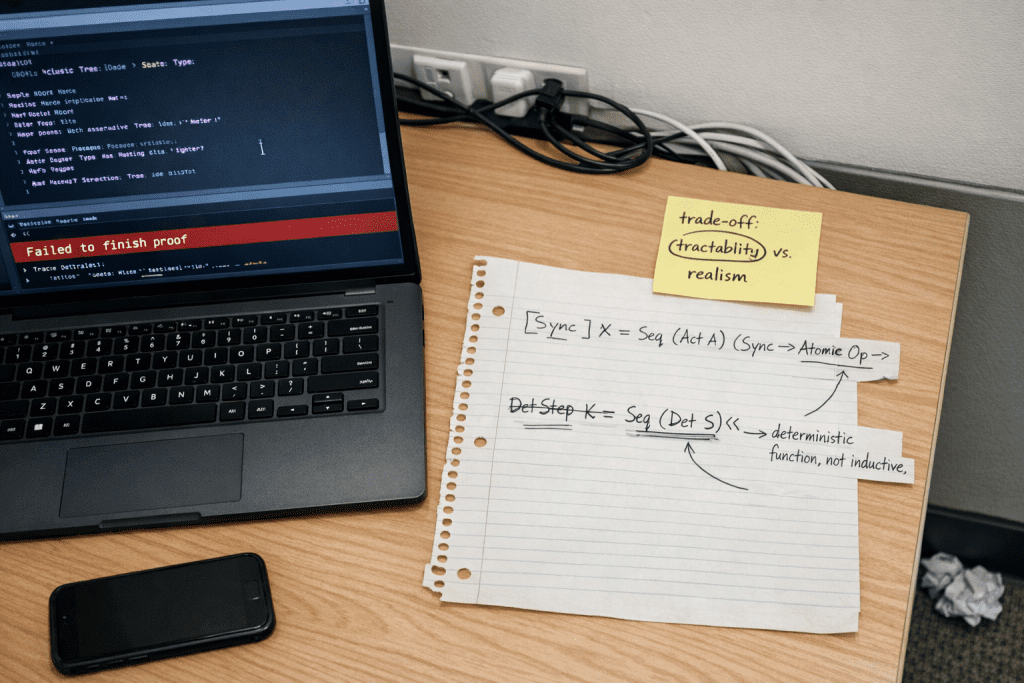
The first proof attempt failed against the partially synchronous model. The handwritten note captures the decision point: tractability won over realism, and sync became atomic.
Model assumption → Implementation reality → Gap mitigation
Atomic sync execution → network delays and partial failures possible → preemptive lock + timeout + automatic release. Instant lock acquisition → distributed lock contention → lock queue + timeout. Honest nodes → Byzantine nodes possible → D-quencer BFT consensus (Property 2).
Proving eventual consistency under partial synchrony, including message delays, retransmissions, and out-of-order delivery, remains a future task within Property 1’s scope. Defining the partially synchronous model in the semi-formal specification was not wasted effort. It marks the point the model must ultimately reach; the current model is the first verification checkpoint on that path.
The State Preservation Locale Hierarchy
The design of the generic theory file was directly inspired by Lochbihler’s Merkle Functor [2]. Lochbihler defined a generic interface called merkle_interface while verifying Canton’s authenticated data structures, then implemented Canton’s transaction trees as an instance of that interface. We follow the same structure: define a generic theory for state preservation, then implement the regulatory domain as an instance.
State_Preservation.thy is 383 lines, with four locales stacked hierarchically.
Locale 1: state_machine
The most fundamental abstraction. It defines finite state sets, finite action sets, a deterministic transition function, and terminal states.
locale state_machine =
  fixes states :: "'s set"
    and actions :: "'a set"
    and transition :: "'s ⇒ 'a ⇒ 's option"
    and terminal :: "'s set"
  assumes finite_states: "finite states"
    and finite_actions: "finite actions"
    and transition_closed: ...
    and terminal_stuck: ...
    and terminal_subset: ...
The key function is apply_actions, which sequentially applies a list of actions. Once a terminal state is reached, all subsequent transitions return None. This single locale suffices to verify whether the ERC-TRUST regulatory state transition model is correctly expressed. Single-chain, single-domain state machine properties belong here.
Locale 2: state_preservation
Defines the structure-preservation relationship between two state machines. It inherits two state_machine locales (source and target) and adds a state mapping (state_map), an action mapping (action_map), and a synchronization function (sync).
locale state_preservation =
  source: state_machine + target: state_machine +
  fixes state_map :: "'s1 ⇒ 's2"
    and action_map :: "'a1 ⇒ 'a2"
    and sync :: "'s1 ⇒ 's2"
  assumes naturality: ...
The core assumption is the naturality condition: the transition function and the synchronization function commute. “First transition, then sync” yields the same result as “first sync, then transition.” The concept comes from natural transformations in category theory.
The key theorem proved at this level is sequential_preservation. If naturality holds for a single action, it holds for action sequences of arbitrary length. The proof proceeds by induction on the action list. Failure (None) preservation is also proved separately (sequential_preservation_none).
Locale 3: symmetric_state_preservation
Defines bidirectional preservation. It adds state_map_inv, action_map_inv, and sync_inv to enable reverse mapping and synchronization. Roundtrip guarantee (sync_inv ∘ sync = id) and state_map_injective (no information loss) are the key properties.
Oraclizer’s state synchronization is inherently bidirectional. Regulatory actions originating on-chain are reflected off-chain, and off-chain events are reflected on-chain. Guaranteeing this bidirectionality at the locale level is the role of this tier.
Locale 4: multi_domain_preservation
Extends beyond a single pair (source-target) to an arbitrary set of domains.
locale multi_domain_preservation =
  fixes domains :: "'d set"
    and domain_state :: "'d ⇒ 'id ⇒ 's option"
    and sm_transition :: "'s ⇒ 'a ⇒ 's option"
    ...
    and sync_all :: "'id ⇒ 'a ⇒ 's ⇒
      ('d ⇒ 'id ⇒ 's option) ⇒ ('d ⇒ 'id ⇒ 's option)"
  assumes finite_domains: "finite domains"
    and all_domains_are_state_machines: ...
The key definition is connected_domains (the set of domains where a given asset exists), and the key properties are cross_domain_consistency (all connected domains agree after sync_all) and sync_isolation (other assets remain unchanged).
The design rationale for this 4-tier structure is separation of concerns. Single state machine properties, pairwise preservation, bidirectional preservation, and multi-domain preservation are each proved independently, with each higher locale inheriting all theorems from below. When instantiating the regulatory domain in Regulatory_Instance.thy, we can choose how far up the hierarchy to instantiate.
Figure 1: Locale Hierarchy and Theorem Propagation in State_Preservation.thy
Regulatory_Instance.thy: Formalizing the Regulatory Domain
The regulatory instance file is 1,053 lines, roughly 2.7 times the generic locale’s line count, because concrete definitions, auxiliary lemmas, and proofs all reside in this file.
Formalizing States and Actions
The semi-formal specification’s states and actions translate directly into Isabelle’s datatype.
datatype reg_state = ACTIVE | FROZEN | SEIZED | CONFISCATED | RESTRICTED
datatype reg_action = FREEZE | SEIZE | CONFISCATE | RESTRICT
                    | UNFREEZE | UNRESTRICT | RELEASE
The transition table is defined using the fun keyword. In Isabelle, fun defines total functions via pattern matching, and the definition itself guarantees determinism. Of the 35 (state, action) combinations, 12 return Some (valid transition) and the remaining 23 return None (invalid).
fun reg_transition :: "reg_state ⇒ reg_action ⇒ reg_state option"
where
  "reg_transition ACTIVE FREEZE = Some FROZEN"
| "reg_transition ACTIVE SEIZE = Some SEIZED"
| "reg_transition ACTIVE CONFISCATE = Some CONFISCATED"
| "reg_transition ACTIVE RESTRICT = Some RESTRICTED"
| "reg_transition FROZEN UNFREEZE = Some ACTIVE"
| "reg_transition FROZEN SEIZE = Some SEIZED"
| "reg_transition FROZEN CONFISCATE = Some CONFISCATED"
| "reg_transition SEIZED RELEASE = Some ACTIVE"
| "reg_transition SEIZED CONFISCATE = Some CONFISCATED"
| "reg_transition RESTRICTED UNRESTRICT = Some ACTIVE"
| "reg_transition RESTRICTED FREEZE = Some FROZEN"
| "reg_transition RESTRICTED CONFISCATE = Some CONFISCATED"
| "reg_transition _ _ = None"
The final wildcard pattern (_ _) handles all 23 invalid combinations in one line. The fun exhaustiveness checker automatically confirms no cases are missing.
From this definition, an interpretation creates an instance of the state_machine locale.
interpretation reg_sm: state_machine
  reg_states reg_actions reg_transition reg_terminal
This single line means every theorem proved in the state_machine locale now automatically applies to the regulatory state machine. The practical benefit of the locale hierarchy manifests here.
The Global State Model
Global state is defined using Isabelle’s record and type_synonym.
type_synonym asset_id = nat
type_synonym chain_id = nat

record asset_state =
  as_reg_state :: reg_state
  as_owner :: nat
  as_locked :: bool

type_synonym chain_state = "asset_id ⇒ asset_state option"

record global_state =
  gs_chains :: "chain_id ⇒ chain_state"
  gs_locks  :: "asset_id ⇒ chain_id option"
Several abstraction decisions are embedded here. Defining asset_id and chain_id as nat (natural numbers) is a deliberate simplification. In practice, asset_id is a composite identifier and chain_id is an EIP-155 chain ID, but all the model needs is distinguishable identifiers. nat provides equality comparison and finiteness for free.
Note that gs_locks has type asset_id ⇒ chain_id option. Some cid means the asset is locked by an action originating on chain cid; None means no lock. Recording the source chain at lock time provides information needed for debugging and rollback, and in proofs it enables tracing the cause of a lock.
The oss_queue (message queue) present in the semi-formal specification was removed from the final model. Under the atomic sync assumption, modeling a message queue introduces unnecessary complexity. Messages are defined as oss_message records but are passed directly as parameters to the sync function rather than stored in a queue.
The Core Function: Structure of sync
The sync function encapsulates the entire synchronization workflow in a single function: lock acquisition → transition validation → all-chain update → lock release.
definition sync ::
  "global_state ⇒ chain_id ⇒ reg_action ⇒ asset_id
   ⇒ nat ⇒ nat ⇒ global_state option"
where
  "sync gs src act aid auth ts = (
    case get_reg_state gs src aid of
      None ⇒ None
    | Some current_st ⇒
      (case reg_transition current_st act of
        None ⇒ None
      | Some new_st ⇒
        let gs_locked = acquire_lock gs aid src in
        let targets = connected_chains gs aid in
        let gs_updated = update_all_chains gs_locked aid new_st targets in
        Some (release_lock gs_updated aid)))"
The most important sub-function in this definition is update_all_chains. It propagates a given asset’s regulatory state to all connected chains. How this function is defined turns out to determine the difficulty of every subsequent proof, a story we explore in detail in the next article.
The connected_chains function returns the set of chains on which a given asset exists.
definition connected_chains ::
  "global_state ⇒ asset_id ⇒ chain_id set"
where
  "connected_chains gs aid =
    {cid. ∃ast. gs_chains gs cid aid = Some ast}"
This set is dynamic. It changes as assets are registered on new chains or burned. In proofs, consistency is guaranteed relative to connected_chains at the moment sync executes.
The Valid State Invariant
We must define what it means for a global state to be “valid.” This serves both as a proof precondition and as a proof conclusion (does sync preserve valid state?).
definition valid_state :: "global_state ⇒ bool"
where
  "valid_state gs ⟷ consistent_state gs ∧ no_locked_without_reason gs"
Separating the two conditions produced a cleaner proof structure. consistent_state means the regulatory state of a given asset agrees across all chains where it exists; this is the definition of cross-domain state preservation itself. no_locked_without_reason is lock integrity: an asset flagged as locked must have a corresponding entry in gs_locks, and vice versa.
Keeping these two conditions separate rather than merging them was intentional. In proofs, preservation of each condition can be established independently. A merged invariant forces unnecessary condition-splitting work during proof.
What the Modeling Process Revealed
Writing code surfaced things invisible at the semi-formal specification stage.
The interpretation collision problem. After registering the reg_sm: state_machine interpretation, attempting to instantiate the multi_domain_preservation locale triggered name collisions with the existing interpretation. The solution was to separate the state_machine predicate into a standalone lemma and reference it directly during instantiation. This was a point where our understanding of Isabelle’s locale system deepened.
Natural reflection of the SEIZED→FROZEN exclusion. The transition we excluded in the semi-formal specification on legal and proof-complexity grounds was automatically handled as None by the wildcard pattern in reg_transition. A design decision reflected in code without additional work is a small piece of evidence that the model is consistent with the specification.
The inductive invariant nature of valid_state. Initially, we thought of valid_state as a simple precondition. But proving that sync preserves valid_state turns it into an inductive invariant: if the initial state is valid, then validity holds after arbitrarily many synchronizations. This property (valid_state_preservation) is essential for long-term system stability and is independently important from the core theorem regulatory_homomorphism. This was something we did not anticipate at the specification stage.
sync function (deterministic)datatype + funglobal_state without queuenatvalid_state = 2 separable conditionsFigure 2: From Semi-Formal Specification to Formal Model — Abstraction Decisions
The Proof Target in Formal Terms
The core theorem to be proved on this model is regulatory_homomorphism.
theorem regulatory_homomorphism:
  assumes "valid_state gs"
    and "get_reg_state gs src aid = Some current_st"
    and "reg_transition current_st act = Some new_st"
    and "sync gs src act aid auth ts = Some gs'"
    and "c ∈ connected_chains gs aid"
    and "asset_exists gs c aid"
    and "connected_chains gs aid ≠ {}"
  shows "get_reg_state gs' c aid = Some new_st"
In natural language: given a valid global state, if a valid regulatory action is applied to an asset on the source chain and synchronization succeeds, then on every chain where that asset exists, the regulatory state equals the new state (new_st).
Compared to the semi-formal expression, the structure is the same but everything is concrete. “Across all connected domains” becomes ∀c ∈ connected_chains gs aid. “Identical state” becomes get_reg_state gs' c aid = Some new_st.
Additional subsidiary theorems are needed: valid_state_preservation (sync preserves valid state) and reg_multi_domain_instantiation (instantiation of the generic locale for the regulatory domain). The proof process for these is the subject of the next article.
From Model to Proof
383 lines of generic theory and 1,053 lines of regulatory instance. A total of 1,436 lines of Isabelle/HOL code constitutes the state preservation model for Property 1. This model encodes every decision from the semi-formal specification into a machine-checkable form.
But a model is not a proof. The existence of definitions does not imply that theorems hold. In fact, the first proof attempt for regulatory_homomorphism after completing the model failed. And the cause of that failure lay in the model definitions themselves.
The next article documents the concrete obstacles encountered during the proof process: how the definition of update_all_chains affected proof tractability, how the interplay between model and proof worked in resolving those obstacles, and how Isabelle’s handling of existential quantifiers differed from what we expected.
Conclusion
The transition from semi-formal specification to formal model was not a “translation” but a redesign.
The largest decision was simplifying the partially synchronous network model to atomic sync. This secured proof tractability but created an explicit gap between the model and reality. That gap was documented rather than hidden, and it points toward the direction of future extensions.
The 4-tier locale hierarchy was inspired by Lochbihler’s Merkle Functor [2] pattern, but the concrete structure was freshly designed for our problem domain. The hierarchy from state_machine to multi_domain_preservation is not specific to the regulatory domain; it applies to any cross-domain synchronization scenario with finite states and deterministic transitions.
The most meaningful discovery during modeling was the inductive invariant nature of valid_state. “Starting from a valid state, validity is maintained after sync” is a mathematical guarantee of long-term system stability. This was not anticipated at the specification stage. The process of constructing a formal model deepens understanding of the design itself.
Open question: how much does the definition of update_all_chains affect proof tractability? The answer to that question could only be found by attempting the proof.
References
[1] Dwork, C., Lynch, N. & Stockmeyer, L. (1988). “Consensus in the Presence of Partial Synchrony.” Journal of the ACM, 35(2), 288-323. https://doi.org/10.1145/42282.42283
[2] Lochbihler, A. & Marić, O. (2020). “Authenticated Data Structures As Functors in Isabelle/HOL.” In: FMBC 2020. OASIcs vol. 84, 6:1-6:15. https://doi.org/10.4230/OASIcs.FMBC.2020.6
[3] Nipkow, T. & Klein, G. (2014). Concrete Semantics: With Isabelle/HOL. Springer. http://concrete-semantics.org/
[4] Nipkow, T., Paulson, L.C. & Wenzel, M.T. (2002). Isabelle/HOL: A Proof Assistant for Higher-Order Logic. LNCS vol. 2283, Springer. https://isabelle.in.tum.de/doc/tutorial.pdf
[5] Lochbihler, A. & Marić, O. (2020). Authenticated Data Structures As Functors. Archive of Formal Proofs. https://isa-afp.org/entries/ADS_Functor.html
Learn More
Read more on Oraclizer Research:
Defining Cross-Domain State Preservation: What Are We Proving? — Semi-formal specification of Property 1, state space design, and threat model definition
Higher-Order Logic as a Design Language: Why Our Verification Requires HOL — Isabelle/HOL selection rationale and HOL fundamentals
Why We’re Starting Formal Verification: Applying Our Own Standard — Pattern 3 self-application motivation and verification target introduction