Skip links
Parallel Processing Architecture of the Oracle State Machine: A Theoretical Exploration for Bidirectional State Sync
Oraclizer's Oracle State Synchronizer (OSS) solves the performance bottleneck of state synchronization through a 3-stage pipeline parallel processing architecture. While event collection, zk proof generation, and external API calls are processed in parallel, state transition verification and conflict resolution are processed sequentially to ensure state consistency. This innovative approach presents possibilities to overcome theoretical limits according to Amdahl's Law, potentially reducing overall processing time by 50-70%.
Oraclizer Core ⋅ Sep 11, 2025
The End of OEV: Oracle State Synchronization as the Ultimate Solution
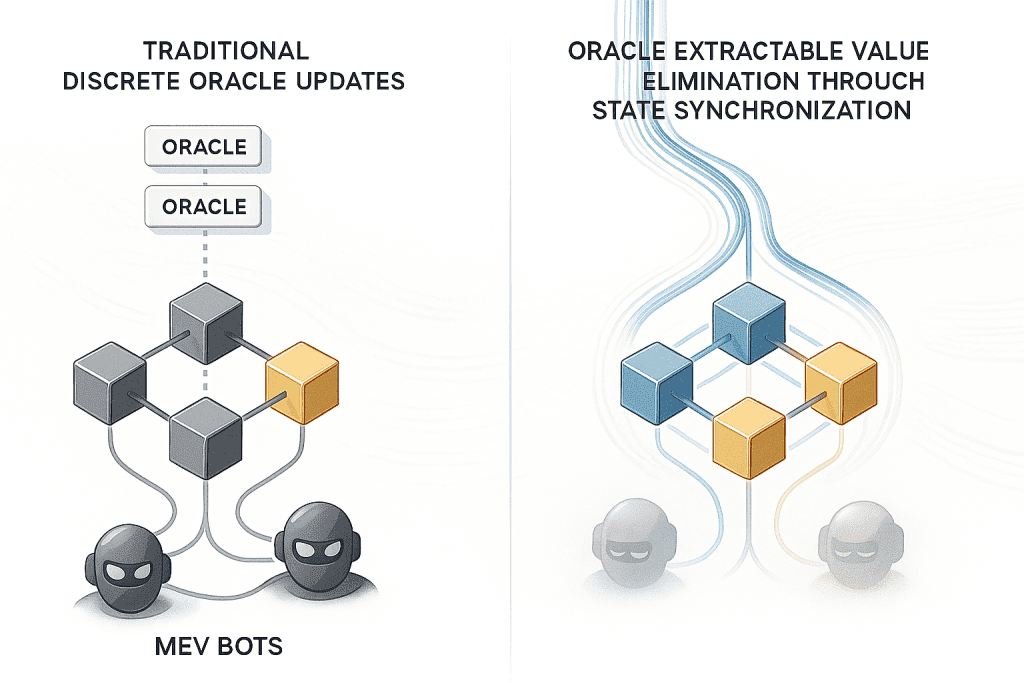
Oracle Extractable Value (OEV) represents a structural problem causing hundreds of millions in hidden costs annually across the DeFi ecosystem. Existing mitigation solutions like Chainlink's SVR, UMA's Oval, and API3's auction systems merely "share" or "redistribute" OEV rather than providing fundamental solutions. Oraclizer's state synchronization approach replaces discrete price updates with continuous state synchronization, eliminating OEV generation at its source.
Oraclizer Core ⋅ Aug 01, 2025
Blockchain as Digital Spacetime and the Inevitability of Oracle State Machine: CPO’s Reflections
Blockchain's irreversible temporality and fully-connected spatiality exhibit remarkable isomorphism with modern physics' concepts of spacetime. Within this digital spacetime, the oracle state machine emerges not as mere technical innovation, but as an inevitable evolutionary stage in information physics. Just as quantum gravity unifies classical mechanics and quantum mechanics, Oraclizer realizes a theoretical leap that connects separated information spacetimes into one unified information universe.
Oraclizer Core ⋅ Jul 28, 2025
State Synchronization and DeFi Protocol Integration
Oracle state machines fundamentally expand the smart contract paradigm of existing DeFi protocols. While traditional data point oracles were limited to unidirectional information delivery, state synchronization mechanisms ensure complete state consistency between off-chain and on-chain systems, evolving DeFi ecosystem composability to a new dimension. Through atomic state transitions and cross-chain state invariant guarantees, this achieves true financial contract finality that existing DeFi protocols could never accomplish. This represents not merely technical improvement, but a paradigm shift in DeFi architecture itself.
Oraclizer Core ⋅ Jul 27, 2025
Rollback Mechanisms in Oracle State Machines: Resolving the Paradox of Immutability and Enforceability
Rollback mechanisms in state synchronization oracles represent an extraordinarily complex technical challenge that the blockchain industry must implement for the first time. To resolve the contradiction between traditional blockchain's immutability principles and enforceability for regulatory compliance, we have designed a Byzantine Fault Tolerant multi-layered rollback architecture.
Oraclizer Core ⋅ Jul 08, 2025
Behind the Scenes of Oracle State Machine Design: CPO’s Reflections
The journey to conceive the oracle state machine wasn't just a technical innovation—it was a profound exploration that began with deep reflection on the fundamental limitations of existing oracles and led to discovering the new paradigm of complete state synchronization. In this piece, I share the genuine concerns, doubts, and breakthrough moments I experienced as CPO during our design process. We realized that while technical excellence matters, the philosophical foundation of why this technology is necessary matters even more.
Oraclizer Core ⋅ Jun 24, 2025
Cryptographic Proofs for State Synchronization
Oraclizer's state synchronization is implemented through a sophisticated cryptographic proof system based on Zero-Knowledge Proofs. By selectively utilizing zk-SNARK and zk-STARK proof systems depending on the situation, we mathematically guarantee the validity of state transitions between on-chain and off-chain environments. These cryptographic proofs go beyond simple data verification to provide both State Consistency and Transition Integrity simultaneously, while enabling the economic feasibility of large-scale state synchronization through verification cost optimization via the zkVerify network.
Oraclizer Core ⋅ Jun 19, 2025
D-quencer Algorithm Overview
D-quencer is Oraclizer's decentralized sequencing engine that provides Stage 1 rollup-level security. Through a consensus algorithm utilizing BLS (Boneh-Lynn-Shacham) signature-based VRF (Verifiable Random Function), it ensures fair sequencer selection and transaction reliability. In particular, by employing equal stake PoS and multisig-based consensus, it achieves a balance between scalability and security, providing the core foundational technology for regulatory-compliant oracle state machines.
Oraclizer Core ⋅ Jun 10, 2025
Core Components of the Oracle State Machine
Oraclizer's state synchronization architecture consists of five core components: Polygon CDK-based L3 zkRollup infrastructure, zkVerify integrated verification engine, Base L2 bridge connection, Oracle State Synchronizer (OSS), and RWA Registry contracts. Each component performs a specialized role, working together to enable the entire system to complete state synchronization. Particularly, the modular architecture of Polygon CDK and verification optimization through Horizen Labs' zkVerify have made bidirectional real-time state synchronization economically viable—something impossible with traditional oracle systems.
Oraclizer Core ⋅ Jun 04, 2025
The Technical Advantages of Oraclizer Core Architecture
L3 zkRollup architecture serves as Oraclizer's core technological foundation, with its adoption primarily driven by overwhelming advantages in scalability and economic efficiency. In particular, the revolutionary cost efficiency of over 93% gas reduction serves as a decisive differentiator in systems requiring continuous transactions like state synchronization. Additionally, the L3 layer design opens new technological horizons that existing oracle solutions haven't reached in terms of data compression efficiency, processing pipeline optimization, and modular scalability. This isn't merely a technical choice, but an essential architectural decision to realize the innovative paradigm of next-generation oracle state machines.
Oraclizer Core ⋅ May 21, 2025