

TL;DR
- In the autumn of 2026 the United States opened two routes for trading the same listed share as a token: an inside route through DTCC’s tokenization service and Nasdaq’s same-order-book rule, and an outside route through the SEC’s Innovation Exemption, which lets new venues carry tokenized stock trading onto public blockchains.
- Inside, absorption works because one operator keeps the asset’s whole life in its own books. Outside, the SEC had to write synchronization into the conditions, and its demand that trading halt concurrently with the listing exchange is atomic state binding (S3) stated in the language of market structure.
- The boundary of absorption is the number of operators. Nothing yet makes “concurrently” true across ledgers run by different parties, so a pause button and a 0.25% volume cap stand in for the mechanism.
The Week Tokenized Stock Trading Got Two Routes
On September 15, 2026, the U.S. Senate voted 49 to 50 against taking up the Digital Asset Market Clarity Act [1], the bill we read in Tokenized Securities Under the CLARITY Act: The Weight of Codification as a proposition that had arrived but not yet taken effect. Two days later the SEC opened another route. It granted a five-year conditional exemption that lets venues not registered as exchanges trade tokenized versions of U.S.-listed stocks on public blockchains [2].
Meanwhile the Depository Trust & Clearing Corporation (DTCC) had finished a July production trial and was preparing to launch its tokenization service at the end of October [4,5]. The same listed share now had two routes into tokenized stock trading. One runs inside existing market infrastructure, where the token represents a share held at DTC and matches against the traditional share in Nasdaq’s order book [3]. The other runs outside it, in permissioned pools on a public blockchain that keep trading when the listing exchange is closed.
This puts the most uncomfortable question to our own thesis. Since The RWA 2.0 Declaration: Blockchain Innovation That Embraces Legacy, we have argued that a token reflects an asset’s whole life only through continuous, bidirectional state synchronization between on-chain and off-chain systems. If incumbent infrastructure can absorb tokenization wholesale, how much of that claim survives? Walking both routes shows where absorption holds and where it ends.
The Inside Route: How the Same Order Book Absorbs Tokenization
On March 18, 2026, the SEC approved a Nasdaq rule under which a tokenized share keeps the same CUSIP and ticker as its traditional counterpart, matches in the same order book with the same execution priority, and settles through DTC on the usual T+1 cycle [3]. The rule covers Russell 1000 stocks and major index ETFs and takes effect once DTC’s tokenization service is ready.
On July 15, more than 30 institutions ran real trades through that service [4]. DTC tokenized assets in its custody and used them in production for collateral pledges, securities lending, Treasury repo, equity trades and central counterparty margin.
The launch scope points the same way [5]. The service starts with 25 equities, ETFs and Treasuries, issued on Canton and on DTCC’s private network. Every token is backed one for one by a security in DTC’s custody, DTC keeps the official books and records, and tokens move around the clock only between wallets registered with DTC.
On this route a token is a new representation of the same asset. When a coupon is paid, a dividend arrives, a stock is halted or a corporate action takes effect, the operator holding the official books processes the change, and keeping token and books consistent is its internal task. Absorption rests on one operator’s perimeter. Because that operator controls every ledger the token can reach, keeping two domains consistent becomes a problem inside a single domain.
Why Tokenized Treasuries Get Absorbed
Absorbable assets are often read as simple assets. Treasuries and money market funds have stable prices and plain structures, the argument goes, so they fit existing infrastructure, and only complex assets need anything new. That reading misplaces the cause.
A Treasury pays interest and matures. Our sync degree hierarchy sorts assets into four levels by the synchronization they need to perform their financial function. Periodic interest and a maturity date place an asset at Bidirectional Coupling (S2), where transitions in two domains must be bound as one causal unit. Once it becomes the subject of a regulatory action such as a freeze, it rises to Atomic State Binding (S3), where both domains succeed together or fail together. A tokenized Treasury does not demand little.
DTC can absorb it because a single party carries that demand. The hierarchy defines the sync degree over pairs of an asset and a system, so the same Treasury can leave its demand as an internal matter or spread it across several parties, depending on which system handles it. DTC operates every ledger its tokens can reach, so coupons, maturity and freezes resolve in its own books in one pass. What became simple is the shape of the ledger.
The Outside Route: What the Exemption Had to Write Down
The Innovation Exemption opens different ground [2]. A Tokenized Securities Venue carries tokenized stock trading through permissioned automated market maker pools on public, permissionless blockchains, without registering as an exchange. By late October three firms had told the SEC they intend to operate such venues, and one of them plans to run on Canton, the network DTCC uses on the inside route [6]. One chain sits on both routes. What separates them is who holds the books, not the technology.
Of the exemption’s many conditions, three require the token’s state to follow a state that lives somewhere else.
- Same rights. The token must carry the rights and privileges of the underlying share, so dividends and votes must reach token holders. A dividend starts with the issuer and its transfer agent, while the holders sit on a public chain.
- Concurrent halts. When the primary listing exchange halts a stock, the venue must stop trading the token concurrently. The halt is decided in the exchange’s systems, while the trades that must stop happen in a pool on a public chain.
- Issuer objection. For a stock the issuer did not tokenize itself, the venue must notify the issuer and wait 30 days, and an objection in that window keeps the stock off that venue. Issuers object venue by venue.

The halt condition, the moment it clicked: “concurrently” is S3.
Volume is capped too. A stock in the S&P 500 or the Russell 1000 can trade on one venue only up to 0.25% of its prior-month average daily volume, and a venue may list at most 75 such stocks [2].
Side by side, the three conditions read as one specification. Same rights asks every state change on the issuer’s side to reach the holders on the chain, which is bidirectional coupling. Concurrent halts ask that no state exist in which one domain has stopped and the other has not, which is atomic state binding. An issuer objection is a decision by a party with authority that takes effect in particular ledgers. The SEC wrote a synchronization specification in the language of market structure.
What “Concurrently” Asks
What the exemption leaves unwritten is as clear as what it writes. It demands an outcome and leaves the mechanism to the venue. The halt is decided in the exchange’s systems, while the pool runs on a public chain whose block timing the venue does not set. If the interval between decision and effect is not zero, the share is halted while the token keeps trading. Halts often come just before material news, so those seconds are when information is most uneven.
For “concurrently” to mean something, events in the two systems must fall into one order that both sides accept: no trade after the halt time, and agreement on which side of it every trade fell. Two ledgers sharing one order of events is the real condition behind a concurrent halt. On the inside route it comes for free, because there is only one ledger.
The sync degree hierarchy predicts which mechanisms can make a halt concurrent. A feed that reports the halt to the pool, or two such feeds running in opposite directions, works at Unidirectional Observation (S1): the pool learns of the halt only after the trades it should have refused. A mechanism that binds the two ledgers’ transitions into one causal order reaches Bidirectional Coupling (S2), but it settles mismatches by retrying until the ledgers converge, so one ledger can sit halted while the other still trades.
Making either one faster narrows the gap without removing it, because the condition forbids the state itself, however brief. Only atomic state binding meets the condition as written: the halt commits in both ledgers as one transition or in neither, so the in-between state cannot be reached, under one order of events that both sides can check afterward.
The volume cap reads differently in this light. Beyond a judgment about market size, 0.25% limits the size of a gap that cannot yet be closed. U.S. equities traded about $1.1 trillion a day in 2025 [11]. Even a venue that could list every Tier 1 stock would be held to about $2.75 billion a day, and the 75-stock limit keeps the real ceiling lower. Every dollar under that ceiling must halt concurrently. Until a mechanism exists, a pause button and a cap keep the conditions, and the ceiling marks how much trading the market is asked to run without one.
What the Objections Priced In
The market answered quickly. OKXICE, the planned venue of OKX and Intercontinental Exchange (ICE), listed nine objecting issuers in a public notice on October 15 and sixteen on October 19, with Microsoft, Alphabet and Goldman Sachs among the new names [7]. Neither notice gave reasons.
Nasdaq did. As an issuer it said it would keep its own shares off the exemption’s venues, because it did not want them traded where best prices are not displayed in real time and trades are not reported to the consolidated tape. Its FAQ argued that the exemption weakens an issuer’s ability to keep a complete, accurate and contemporaneous view of how its securities are priced and traded [8]. The exchange that won approval for the same-order-book route declined the outside route for its own stock.
Those are synchronization reasons. U.S. equity markets already solved one version of this problem, the same stock trading on many venues, and the consolidated tape and best-price rules are the answer: they bind the prices of scattered venues into one observable state. O’Hara and Ye found that the fragmented U.S. market works like a single virtual market with many points of entry, and that in those conditions fragmentation did not harm market quality [9]. The exemption’s venues stand outside that shared state. What Nasdaq asked for is shared state across venues, which grows from the same root as keeping a token and its share in step.
Where Absorption Ends
Laid over each other, the two routes show where the boundary falls. Absorption holds as long as an asset’s life ends inside one operator’s ledger. While interest, maturity, dividends, corporate actions, halts, freezes and the exercise of rights all resolve in one operator’s books, a token is enough as a new representation in existing infrastructure. The boundary is crossed when the same asset must mean the same thing at the same moment in a ledger another party runs: a venue on a public chain, a DeFi collateral position, a clearinghouse in another jurisdiction.
The inside route approaches the boundary as it grows. DTCC plans to add networks in 2027 [5], and each one is another representation the official books must match. On the collateral side, the European Securities and Markets Authority (ESMA) asked on October 9 whether a central counterparty could access, transfer and convert tokenized collateral into cash if a clearing member defaults [10]. The July trial already ran central counterparty margin, and disposing of collateral in a default is an event in which its state must change in several ledgers together.
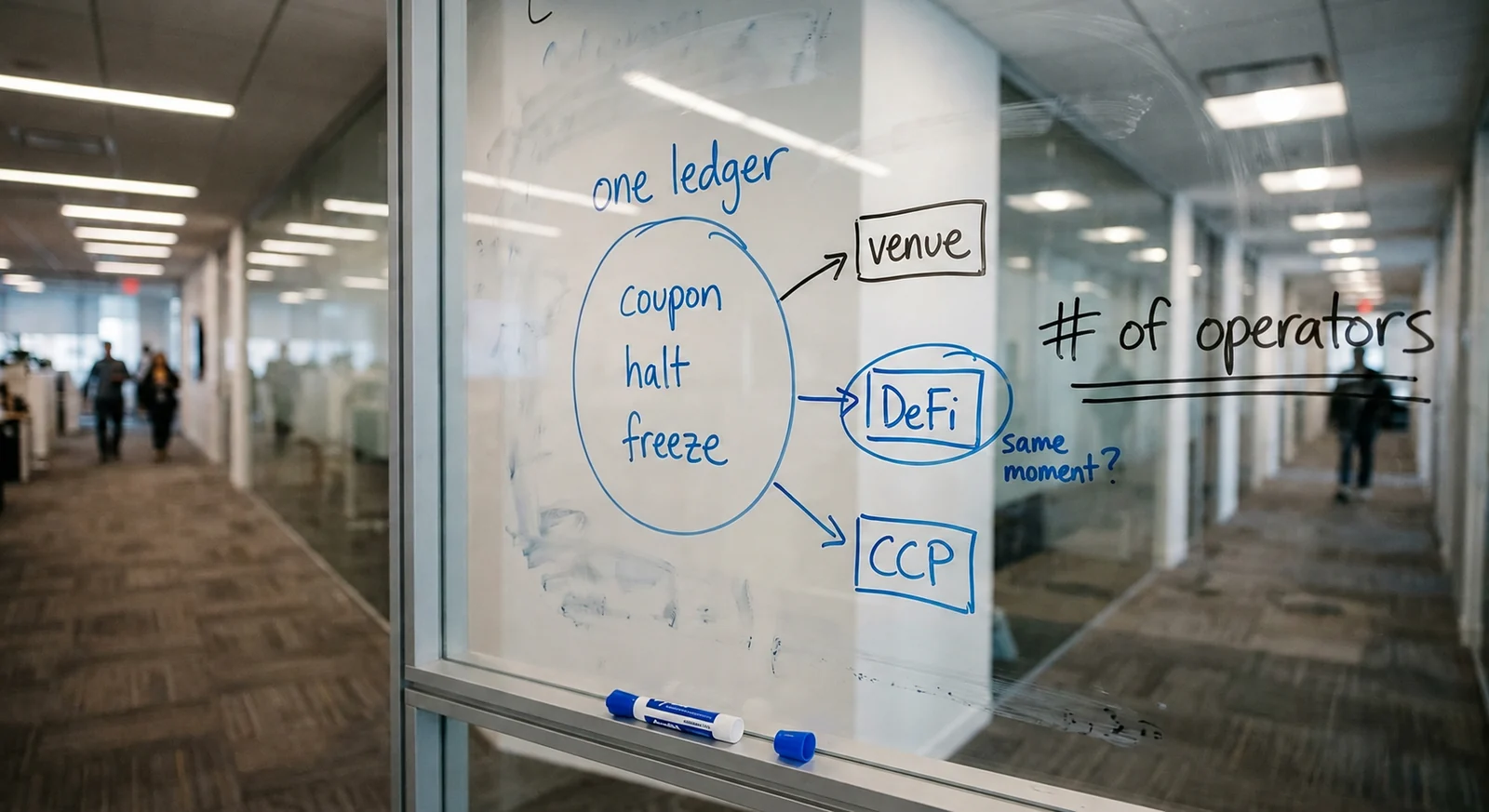
Sorting lifecycle events that end in one ledger from those that cross it.
Restating the RWA 2.0 Claim
This review narrows our thesis. Saying that every tokenized asset needs new infrastructure would overstate it. Much of the tokenized stock trading in large-cap names, and of the trading in tokenized Treasuries, will stay inside incumbent perimeters, where incumbent infrastructure is efficient. The need for new infrastructure begins where the perimeter ends.
The narrower claim is also sturdier, because tokens cross the perimeter by design. The SEC’s exemption exists to let them trade outside it. DeFi collateral, discussed in Why RWA Isn’t Real DeFi Collateral Yet: The Non-Atomicity of the Collateral Layer, has always lived outside it, and so has the cross-border trading examined in Three Layers of Cross-Border Regulatory Conflict in Tokenized Securities. Once a token steps outside, the regulator writes synchronization into the conditions. Starting from market structure, it arrived at the top rung of our sync degree hierarchy.
What remains is atomic state binding between operators, a mechanism that carries those conditions across ledgers run by different parties. Without it, caps and a pause button keep them. Caps are safe, and they keep the market small.
Conclusion: The Market Outside the Same Order Book
The same order book is the route of absorption. While one operator holds an asset’s life, tokenization adds one more representation to existing infrastructure, and that route is real and wide.
On the outside route of tokenized stock trading, synchronization turns from one operator’s internal property into a condition for trading to be allowed at all. The SEC wrote it as one word, concurrently. Where different parties run the ledgers, only atomic state binding makes that word true, and building it is infrastructure work.
So our answer to “if incumbent infrastructure absorbs tokenization, is RWA 2.0 still needed?” is conditional. Where absorption reaches, no. Where it ends, wherever the same asset must mean the same thing in ledgers run by several parties, the need for atomic state binding was there from the start.
Open Questions
- If a halt decision on the listing exchange and a trade on a public chain land in the same second, who decides which came first, and on what evidence?
- When an issuer objects to one venue but not another, where can a holder see that the same token carries a different permission state at each venue?
- Will the consolidated tape extend to tokenized venues, or will tokenized markets build a shared state of their own?
- As DTC adds networks, does the inside route remain one operator’s ledger, or does it become a federation that needs the same synchronization guarantees?
References
- [1] U.S. Congress. (2026). H.R.3633: Digital Asset Market Clarity Act of 2025, All Actions. https://www.congress.gov/bill/119th-congress/house-bill/3633/all-actions
- [2] U.S. Securities and Exchange Commission. (2026). Order Granting Temporary Conditional Exemptive Relief for Tokenized Securities Venues, Release No. 34-106402. https://www.sec.gov/files/rules/exorders/2026/34-106402.pdf
- [3] U.S. Securities and Exchange Commission. (2026). Order Approving a Proposed Rule Change, as Modified by Amendment No. 2, to Amend the Exchange’s Rules to Enable the Trading of Securities on the Exchange in Tokenized Form, Release No. 34-105047. https://www.sec.gov/files/rules/sro/nasdaq/2026/34-105047.pdf
- [4] DTCC. (2026). DTCC Turns Tokenization into Reality: U.S. Trades Successfully Processed Using DTC-Tokenized Assets. https://www.dtcc.com/news/2026/july/15/dtcc-turns-tokenization-into-reality
- [5] DTCC. (2026). DTCC Tokenization Service: Scope at Launch and What’s Next. https://communications.dtcc.com/rs/669-QIL-921/images/DTCC%20Tokenization%20Service%20At-a-Glance.pdf
- [6] TSV LLC. (2026). Public Notice. https://www.tokenizedstockvenue.com/notice.html
- [7] CNBC. (2026). Tokenized stock trading takes off overseas as Goldman, other U.S. companies object. https://www.cnbc.com/2026/10/21/tokenized-stocks-us-companies-object.html
- [8] Nasdaq. (2026). FAQ: SEC Innovation Exemption. https://www.nasdaq.com/docs/listings/faq-sec-innovation-exemption
- [9] O’Hara, M., & Ye, M. (2011). Is market fragmentation harming market quality? Journal of Financial Economics, 100(3), 459-474. https://doi.org/10.1016/j.jfineco.2011.02.006
- [10] European Securities and Markets Authority. (2026). ESMA seeks evidence on the use of tokenised collateral in central clearing. https://www.esma.europa.eu/press-news/esma-news/esma-seeks-evidence-use-tokenised-collateral-central-clearing
- [11] Cboe Global Markets. (2026). 2025 U.S. Equities Year in Review. https://www.cboe.com/insights/posts/2025-u-s-equities-year-in-review