
TL;DR
For the first time in blockchain history, we’re proposing a paradigm shift from pay-per-transaction to continuous service subscription. After completing Oraclizer’s technical design, we discovered that while a single fee model works effectively for 60-70% of RWA cases, the remaining 30-40% suffer from structural risk-return imbalances. This problem cannot be solved with simple price adjustments and requires a fundamental redefinition of blockchain economics. State Subscription is an innovative concept combining technical state subscription with economic subscription payments, breaking the 15-year-old paradigm of one-time blockchain transactions and presenting Web3’s first true subscription economic model.
Introduction: The Beginning of a New Research Domain
Discoveries from Core Research
After months of intensive research, we completed the technical architecture of the oracle state machine. From the L3 zkRollup structure to D-quencer’s consensus algorithm, and the interactions between each core component, we systematically built our system.
From a technical perspective, our design was successful. The combination of L3 layering, Validium approach, zkVerify integration, incremental proofs, and SMT (Sparse Merkle Tree) optimization demonstrated remarkable efficiency. For most RWAs, continuous state synchronization became possible with single fees comparable to Chainlink’s level.
But our moment of celebration was brief. As we analyzed deeper, we faced a fundamental question:
“Does this design have an economic balance mechanism?”
This question led us into an entirely new research domain, ultimately resulting in the birth of an unprecedented concept in blockchain history: the State Subscription Economy.
The Starting Point of Economy Research
The realization that technical success alone is insufficient was both humbling and revolutionary. While our system was technically efficient, it harbored serious imbalances from the perspective of economic sustainability.
Particularly, the structure where node operators bear 95% of operational risk while revenue only increases linearly was unsustainable. This wasn’t a problem that could be solved by simply adjusting prices or changing fees. We needed to design a completely new economic system.
Blockchain and the Historical Impossibility of “Subscription”
15 Years of Pay-per-Transaction DNA
From Bitcoin’s birth in 2009 to the present, blockchain’s economic model has maintained remarkable consistency. Every transaction is one-time, every execution is immediate, and every payment is completed at the moment of transaction.
This wasn’t just a design choice but a fundamental principle etched into blockchain’s DNA:
- Bitcoin: Pay fee when sending, transaction completes, done
- Ethereum: Pay gas when executing smart contracts, execute, done
- DeFi: Pay fee when swapping/lending/staking, process, done
The “send and forget” culture was so universal that nobody questioned it for 15 years.
Technical and Economic Limitations
Why did nobody attempt a subscription model on blockchain? The reasons are clear:
High Barriers of State Preservation Costs
Continuously maintaining state on blockchain incurs enormous costs. State must be updated every block, the entire network must reach consensus on it, and every node must store this state permanently.
Impossibility of Continuous Service Provision
Traditional oracles fetch data once and that’s it. The concept of continuous service itself didn’t exist. It was just repetition of new request, new payment, new execution every time.
Unpredictable Gas Fee Structure
Gas fees that fluctuate wildly based on network congestion made fixed-price subscription models impossible. If a service that costs $10 today can cost $100 tomorrow, how can you set a monthly subscription fee?
The Fundamental Principle of Blockchain Economics
The traditional economic structure of blockchain can be expressed in this simple formula:
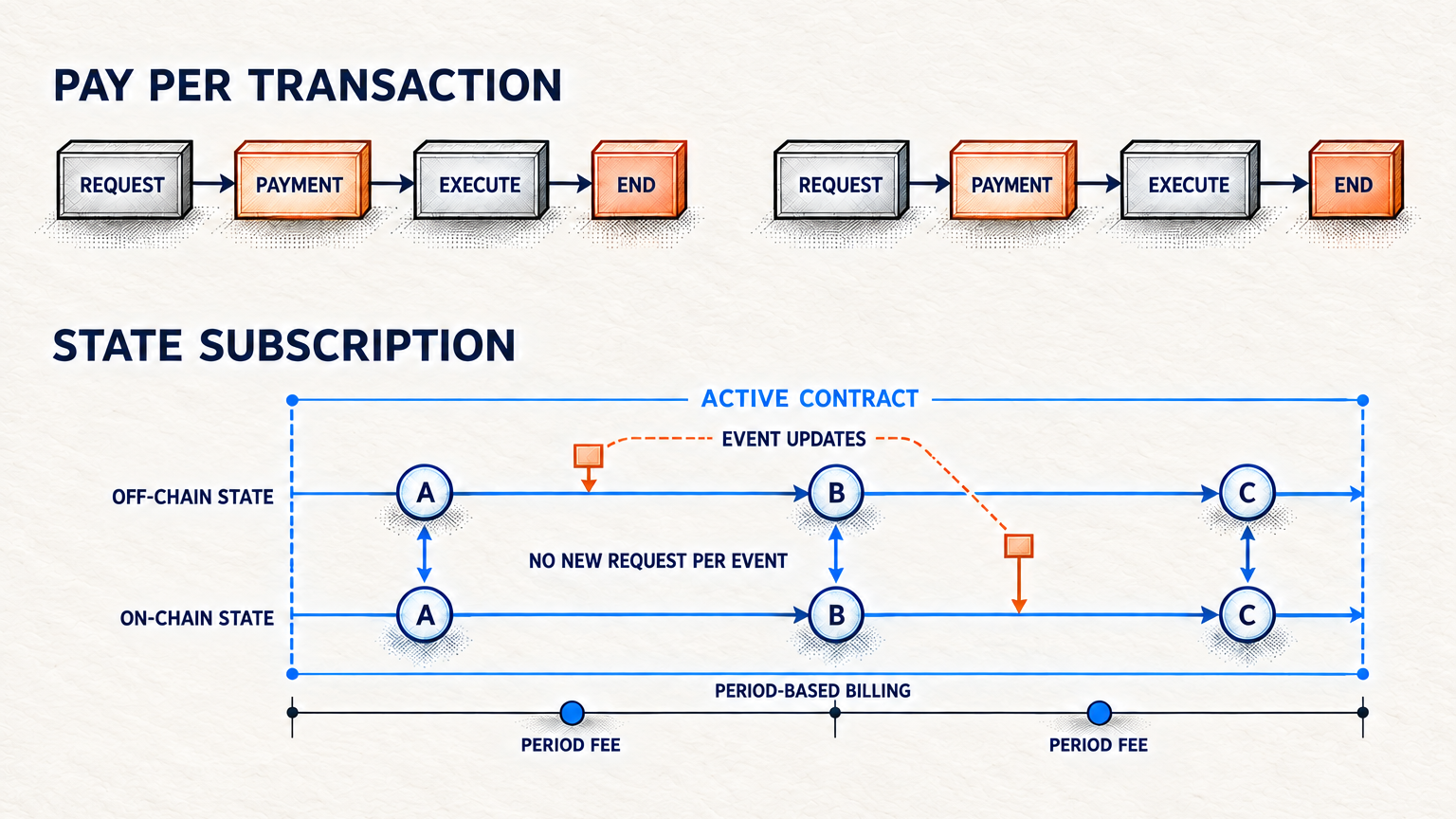
1 transaction = 1 payment = 1 execution = termination
Every value exchange is atomic, pursuing immediacy rather than persistence. This remained unchanged for 15 years due to the combination of technical constraints and philosophical beliefs.
The Birth and Revolutionary Essence of State Subscription
Why Is It Possible Now?
The emergence of oracle state machines completely changed the rules of the game. Unlike traditional oracles that simply transmit data, oracle state machines continuously synchronize state between on-chain and off-chain.
This is a fundamentally different service category:
- Data transmission ≠ State synchronization
- One-time request ≠ Continuous flow
- One-way delivery ≠ Bidirectional synchronization
The structural characteristic of continuous state flow inevitably demands a new economic model. Paying for a new API call each time versus continuous state synchronization after a single connection are fundamentally different value propositions.
The Definition of State Subscription
We’ve named this new economic model State Subscription:
State Subscription = Technical State Subscription + Economic Subscription Payment
Technical State Subscription
From the technical side, State Subscription has these characteristics:
- Automatic synchronization of all state changes after initial oracle contract
- Bidirectional continuous flow between on-chain↔off-chain
- Uninterrupted connection maintained until contract termination
- Automatic reflection of state changes without additional requests
This already technically possesses the characteristics of “subscription.” Once started, the service is provided continuously.
Economic Subscription Payment
From the economic side, State Subscription is revolutionary:
- Continuous billing model for continuous service
- Period-based rather than usage-based pricing
- Predictable cost structure
- Fair distribution of risk and revenue
Importantly, this is not simply a Netflix-style subscription. It’s not users subscribing, but states being subscribed. This is a completely new economic structure.
Fundamental Differences from Traditional Models
| Characteristic | Pay-per-Transaction | State Subscription |
|---|---|---|
| Service Nature | One-time execution | Continuous synchronization |
| Cost Structure | Increases proportionally with usage | Fixed + unlimited |
| Value Creation | Immediacy | Accumulation |
| Economic Principle | Atomic exchange | Persistent flow |
| Risk Distribution | User bears | Provider-user shared |
| Predictability | Low (gas fee volatility) | High (fixed costs) |
The Historical Significance in Blockchain Economics
The Evolution Stages of Blockchain Economics
Blockchain economics has gone through the following evolutionary stages:
- 1st Generation (Bitcoin, 2009): Simple value transfer – “Digital currency”
- 2nd Generation (Ethereum, 2015): Programmable money – “Smart contracts”
- 3rd Generation (DeFi, 2020): Decentralized financial services – “Money legos”
- 4th Generation (State Subscription, 2025): Continuous service economy – “Blockchain’s subscription economy” ← We are here
Each generation overcame the limitations of the previous one while opening new possibilities. State Subscription marks the turning point where blockchain evolves beyond a simple transaction platform to become a true service platform.
The Essence of the Paradigm Shift
The 15-year-old equation “blockchain = one-time transactions” has finally been broken.
This is not merely a technical innovation. It’s liberation from the economic structure created by technical limitations and proof that decentralization and continuous services can coexist.
State Subscription brings the following fundamental changes:
- From transaction-centric to service-centric
- From immediate completion to persistent relationships
- From unpredictable to predictable
- From risk concentration to risk distribution
New Possibilities Enabled
The possibilities opened by State Subscription are limitless:
Real-time State Reflection of RWAs
The state of tokenized real assets like real estate, bonds, and stocks is reflected on-chain in real-time. Rather than paying for each update, the latest state is continuously maintained through subscription.
Complete Synchronization of Cross-chain Assets
Assets distributed across multiple blockchains synchronize seamlessly. True interoperability is realized where changes on one chain are automatically reflected on all other chains.
Continuous Guarantee of Regulatory Compliance
Financial regulation is not one-time but continuous. Through State Subscription, tokenized assets can be guaranteed to always meet the latest regulatory requirements.
The Complete Picture of the State Subscription Economy
Core Components of the Economic System
Key areas we need to explore to build the State Subscription Economy:
Understanding Cost Structure
What is the actual cost of continuous state flow? What is the relationship between the fixed cost of initial connection setup and the variable cost of continuous synchronization? How do economies of scale work, and when do they reach the tipping point?
Designing Price Models
How do we accommodate various usage patterns? How do we realize fair value distribution between light and heavy users? What role should Entry/Growth/Enterprise tiers each play?
Integration with Token Economics
How should the OZ token circulate in this new economic system? How should the Fee-to-Reward conversion mechanism be designed? How do staking and economic security connect?
System Stability
How should risk be distributed? How should the insurance mechanism work? What about response to black swan events? How do we ensure long-term sustainability?
Fundamental Questions to Solve
Our research must answer these fundamental questions:
- The Nature of Cost: What is the real cost of continuous service? Does marginal cost really approach zero?
- Measuring Value: How do we quantify the value created by state synchronization? What’s the value difference between one-time data transmission and continuous state synchronization?
- Criteria for Fairness: What is a fair economy for node operators, the platform, and users? What’s the optimal distribution ratio of risk and revenue?
- Sustainability: What mechanisms allow the system to grow autonomously without external subsidies? How do network effects work?
The Research Journey Ahead
Core Areas to Explore
Key research areas we’ll explore through the Economy category:
Economics of Cost Structure
In the next research, we’ll closely analyze the cost components of continuous state flow. We plan to mathematically model the relationship between fixed and variable costs, cost structures by usage pattern, and the exact conditions where economies of scale are realized.
Price Models and Value Distribution
Through mathematical optimization of multi-tier pricing models, we’ll design value propositions suitable for each user segment. The key challenge is how to create an inclusive price structure while preventing cross-subsidization.
Token Economics and Incentives
We’ll explore the role and circulation mechanism of OZ tokens, staking economics, and incentive design that maximizes network effects. The balance between token velocity and value capture is crucial.
System Stability and Growth
We’ll research how to design insurance pools, risk management, dynamic parameter adjustments, and build self-reinforcing growth cycles. The goal is designing a resilient system sustainable even during crises.
Research Methodology
Our research will follow these rigorous methodologies:
- Game Theory: Analyzing participants’ strategic behavior and aligning incentives
- Mechanism Design: Designing fair rules that produce desired outcomes
- Mathematical Economics: Expressing all claims in formulas and optimizing parameters
- Simulation: Verifying system behavior under various scenarios
Conclusion: The Dawn of Economy Research
The Meaning of State Subscription
State Subscription is blockchain’s first true subscription model in history. This is not simply a change in billing method but a historical turning point in the paradigm of one-time transactions.
What we’re proposing is not new technology. It’s the new economics inevitably demanded by the technology of oracle state machines. Continuous services like state synchronization require continuous economic models, and State Subscription is the answer.
Toward a Complete Economic System
“We’ve achieved a technical breakthrough. Now it’s time to design the economy that sustains it.”
“State Subscription is not just an idea. It’s a fundamental redefinition of blockchain economics.”
Oraclizer Core Team
We now expand our perspective from technical research to economic research, from efficiency to sustainability, from partial optimization to system balance.
The Vision of the State Subscription Economy
The Economy research ahead will be a process of completing one giant puzzle. Each piece of research is one puzzle piece, and all pieces together will compose a complete State Synchronization Economy.
We’ll progress from theory to practice, from research to implementation. And in that process, we’ll write a new chapter in blockchain economic history.
The true service economy of the Web3 era begins. The age of one-time transactions has ended. The era of the State Subscription Economy has opened.
This analysis is a research study that models the economic sustainability of state synchronization mechanisms. All parameters, formulas and APY figures are theoretical estimates under stated assumptions and may be revised as the research progresses. It is not investment advice, a guarantee of returns, or an offer to buy or sell any token or other asset.
References
[1] Nakamoto, S. (2008). Bitcoin: A Peer-to-Peer Electronic Cash System. https://bitcoin.org/bitcoin.pdf
[2] Buterin, V. (2014). Ethereum White Paper: A Next-Generation Smart Contract and Decentralized Application Platform. https://ethereum.org/en/whitepaper/
[3] Oraclizer Core Team. (2024). Oraclizer: The Oracle State Machine Ensuring Regulatory Compliance. White paper.
[4] Oraclizer Core Team. (2024). A Regulatory Compliance Protocol for Asset Interoperability Between
Traditional and Decentralized Finance in Tokenized Capital Markets. Research Paper.